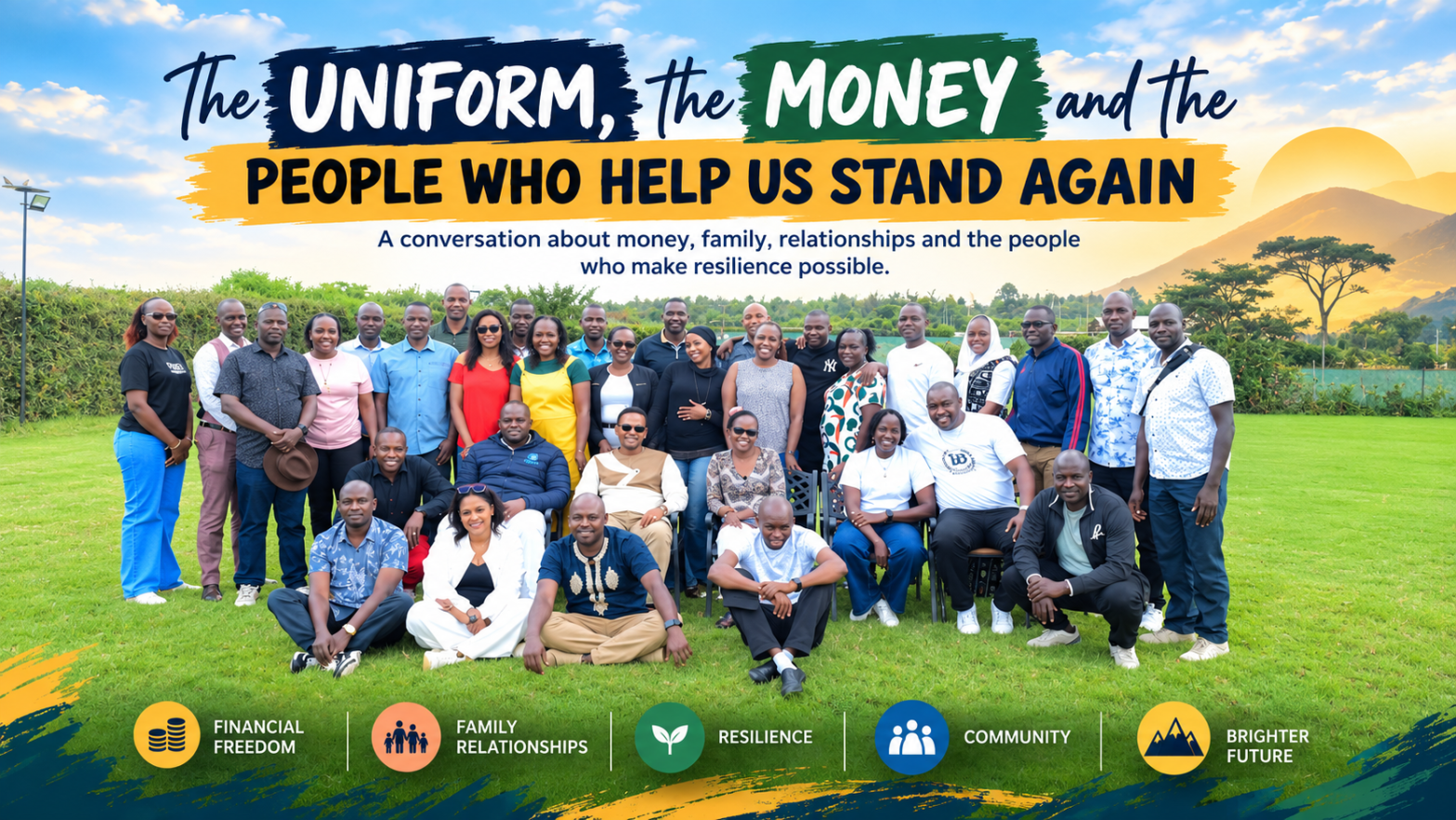
What began as two conversations about financial freedom and life beyond the uniform became a much bigger reflection on family, relationships, resilience and the future we are building.
On Friday, 30 October 2026, I had the privilege of spending part of the day with colleagues from the Kenya Air Force who joined the service in 2009 at Esiakinki Resort & SPA, in Nanyuki.
About 30 participants gathered for two conversations:
Beyond the Uniform: Building Financial Freedom and a Future That Lasts.
Beyond the Barracks: Building Resilient Families, Stronger Relationships and Lasting Legacy.
It was my first time engaging this particular group as a guest speaker. And what a conversation it turned out to be!

The room brought together men and women from a demanding professional environment.
Many of whom understand discipline, teamwork, responsibility and the importance of preparing for the unexpected.
But we were not there to discuss military operations.
We were exploring something equally important:
How to prepare for life beyond the demands of work. Build financial security. Nurture relationships. And create a legacy that lasts.
My invitation was to share practical lessons. Not to deliver a lecture from the mountain of having life completely figured out.
I drew from my own experiences, including the disruption of losing my USAID-funded job in 2025.
And, as it turned out, we had quite a bit to talk about.

1. When the salary stops, the bills don’t
We began with a simple question:
If your salary stopped tomorrow, what three things would your household still need to pay for?
Rent. School fees. Loans. Food. Utilities.
The answers came quickly. Bills, apparently, do not receive termination letters. Neither does the school calendar!
I shared how losing my job in 2025 forced me to confront some uncomfortable questions about savings, debt, spending and how much of our lives depend on a regular salary.
We explored emergency funds, investing, retirement planning and the importance of understanding the true cost of borrowing.

One practical exercise was to calculate six months of household expenses. The responses suggested that preparing for an income interruption is easier said than done.
We also discussed how to make money work beyond the monthly payslip.
Including savings, money market funds, government securities and investments aligned with specific family goals.
But the conversation was not simply about accumulating money. It was about creating options.
One lesson stood out: financial resilience is built before the crisis, not during it.
My family’s experience of gradually reducing our spending over the years helped cushion us when my income disappeared.
It wasn’t glamorous. But neither is financial panic.

2. The future needs more than a pension
We then turned to life beyond formal employment.
I shared a family reflection:
My father retired in 1997 after 28 years of service. He has now spent almost as long in retirement as he spent working.
That is worth thinking about.
- How long might retirement last?
- What will it cost? and
- What are we doing today to prepare for those years?

Participants identified several possibilities for building options beyond their current careers…
From farming, security and construction to training, hospitality, photography, mechanics and professional development.
The challenge, of course, is finding the time and resources to explore these interests while working full-time.
But perhaps the starting point is not to resign tomorrow and open a business.
It is to begin learning. Experimenting. Building relationships. And testing an idea while you still have a regular income.
Your current job can be a platform for preparing for your next chapter, not a reason to postpone it.

3. Money is important. But who is standing with you?
The second conversation took an interesting turn.
We explored what makes a family resilient when life gets difficult.
Using a tree as an illustration, we reflected on roots, trunks and the support systems that help us withstand storms.
Roots represented values, purpose and relationships.
The trunk represented communication, adaptability, self-control and resilience. The branches reminded us of the people and support systems around us.

Then came a question that got people moving:
Would you rather have a lot of money but an unstable family, or a stable family with very little money?
A few participants confidently chose money. Arguing that money could buy happiness, stability and even peace of mind.
One participant cheekily suggested that she might tolerate a slap from her spouse if it came with Ksh. 100,000!
The remark was provocative and drew laughter, but it also opened the door to a more serious conversation about what money can, and cannot, make acceptable.
It brought to mind Sauti Sol’s Money Lover: “Heri ulie kwenye Range Rover, ama ucheke kwenye boda boda?” (Better to cry in a Range Rover, than laugh on a boda boda!)
A good laugh, perhaps, but no amount of money should cost you your safety, dignity or peace of mind.
But most chose a stable family, even with limited resources.

My challenge was simple:
- Why should we have to choose?
- Why not pursue financial stability while intentionally building healthy relationships?
Money matters. But so do the people with whom we share the journey.
I shared how my family, my wife and our three children, has been an important source of strength through seasons of uncertainty.
We may not always have everything we want. But relationships give us people to lean on, laugh with and celebrate with.

4. Build your support network before you need it
We also explored a question many of us rarely consider:
If something unexpected happened tomorrow, who would you call?
Who could help if your child became seriously ill?
Who would listen if you lost your job? Who could offer honest advice when you were struggling?
It is easy to assume that support will appear when we need it. But meaningful relationships are built over time.
I introduced the idea of relationships as bank accounts.

Every check-in, act of kindness, honest conversation, expression of appreciation and moment of reliability is a deposit.
You cannot keep making withdrawals from relationships into which you have never deposited.
The participants brought their own perspectives to the conversation,
Reminding us that support is not just about having people to call. It is also about being someone others can call.
For those in demanding careers, this matters even more.
Professional teamwork, trust and communication are valuable, but they need to travel home with us.
The discipline of leaving no one behind should not end at the workplace or in the field.

5. Resilience also means looking after yourself
One of the meaningful parts of the discussion was around personal well-being.
I shared some of the practices that helped me navigate a difficult season:
Writing. Walking. Gardening. Prayer. Rest. Healthy eating. Mentorship and Therapy.
Yes, therapy. Sometimes we need a safe space to process what we are carrying rather than pretending we are fine.
We talked about recognising stress. Asking for help. And avoiding unhealthy coping mechanisms such as isolation and excessive drinking.
One participant later asked why I appeared so happy in some photographs taken during a difficult season.

My answer was that resilience does not mean you never struggle. It means you learn to find healthy ways of carrying the struggle.
Sometimes the most strategic decision you can make is to take a walk. Speak to someone you trust.
Or close your eyes for a nap, instead of pretending to be productive.
And, for the record, an afternoon siesta can be a legitimate contribution to national development. I can defend that position!

6. Presence is part of the legacy
We closed by reflecting on parenting, relationships and the kind of legacy we want to leave.
One thought I shared was that presence is more important than proximity.
Being physically near our children does not automatically mean we are emotionally present.
A predictable phone call. Asking about their friends. Remembering a birthday or taking time to listen can make a difference.

I invited participants to identify one action they could take in the next 30 days:
- One action to strengthen their family relationships.
- One deposit into an important relationship.
- One habit to support their personal well-being.
Small actions, consistently practised, can shape the kind of families and communities we become.

What I Carried Away from Nanyuki
I left with several reflections of my own.
First, financial conversations must meet people where they are.
It is useful to discuss investments and compounding. But some people first need help navigating debt, financial pressure and difficult decisions. We cannot assume everyone is starting from the same place.
Second, family conversations need room for different realities.
Not everyone is married or in a healthy relationship. Some are single parents, separated, divorced or navigating difficult family circumstances.
At the end of the session, participants even teased me about my rather frequent, unconscious references to ‘my wife and I’ — a gentle reminder that not everyone’s story looks the same! 😄
Future conversations must make space for these experiences without judgement.
Third, people want practical conversations.
Feedback from 11 participants was encouraging: all said they would recommend the sessions.
Investment and retirement planning topped the topics they wanted to explore further (8/11). Followed by family relationships, personal growth, mentorship and entrepreneurship (7/11 each).
A promising sign that the conversations are worth continuing!

Amina captured the heart of the engagement beautifully during her vote of thanks:
“A great speaker does not just speak to an audience; a great speaker leaves an audience with a reason to rise, a courage to act and a determination to become better.”
Her words were deeply encouraging and reminded me why I value these conversations.
It’s not simply about sharing content. It’s about sparking reflection, inspiring action and leaving people with something meaningful to carry forward.
Finally, I was reminded that a good conversation is not measured only by how much the facilitator manages to say. It is also measured by what participants begin to question, reconsider and act on.
I had planned to share more, but time had other plans. The slides were not the only things that needed a little more room!
I am grateful to the organisers for the invitation, the warm reception and the openness with which the participants engaged.
The questions, differing opinions, humour and honest reflections made the conversations worthwhile.

Beyond the Uniform, Beyond the Storm
The two sessions reinforced something I have been learning through my own journey: resilience is not simply about surviving a storm.
It is about the people, habits, choices and relationships that help us stand again.
We need financial plans that give us options.
We need families and friendships worth investing in. We need healthy ways to process life’s pressures.
And we need to prepare for the chapters that come after the roles, titles and uniforms we wear today.
Perhaps the most important question is not simply, What are you building while you are working?
It is also: What are you building that will still matter when the work changes?
A Few Related Reflections
If these conversations resonate with you, you may also enjoy:
- Maintaining Resilience: Lessons from Buhler Kenya
- Don’t Wait for the Storm: Building Before the Waters Rise
- Transformative Conversations: Insights from DICE Ministry
- The Egg, the Calculator and the Crisis Cushion
- Between What We Wanted to Be and What We’re Becoming
- From Closed Gates to New Purpose: A Journey of Faith, Hustle and Small Wins
Your Turn
If your income stopped tomorrow, what would be the first thing you would wish you had prepared?
And beyond money, who are the people you are intentionally investing in, and who is investing in you?
Let’s keep the conversation going.
#BeyondTheUniform #FinancialResilience #FamilyMatters #StillStanding #GrowthCommunities #BuildingResilience
Joseph Ngaara is inspired by people’s stories, especially those shaped by faith, resilience, and grace. If you’ve walked through triumph, tragedy, or something beautifully in between and feel ready to share, my inbox is open. 📩 j.mungai@hotmail.co.uk
Curious to go deeper? Visit the Home Page explore Growth Communities, or join the conversation on YouTube.